Blog
Explore news, articles, outcomes, and legal resources by category or practice area.
Thank you! Your submission has been received!
Oops! Something went wrong while submitting the form.
deselect
No items found...
Keogh Cox is pleased to congratulate Partner, Kirk L. Landry, who recently began his three-year term on the Board of Directors of the Louisiana Association of Defense Counsel!
https://www.ladc.org/leadership


In South Alexander Development I, LLC v. Markel American Insurance Co., the U.S. District Court for the Middle District of Louisiana granted an insurer’s motion for summary judgment finding that the insured’s failure to cooperate violated the policy’s coverage terms and voided coverage.
The dispute arose from a commercial first-party property loss following Hurricane Ida. The insurer moved quickly to adjust the claim by retaining an independent adjuster and engineers to evaluate the damage to and value of the insured property. It also asked the insured to produce documentation needed to complete the adjustment, including records of installation costs, monthly revenues, and repair estimates. The insured did not respond.
Additionally, the insurer sent numerous emails over the course of the claim requesting information about (1) the costs the insured had incurred; (2) documentation supporting the income loss claim, along with quotes, estimates, and proposals for repairs; and (3) the scope of work for testing and repairs. However, most of these requests went unanswered.
Based on this evidence, the court determined that the insured violated the terms of the policy because it failed to cooperate with the insurer’s investigation. Most notably, the insured obtained repair estimates and proposals from its own contractor and withheld them from the insurer until after suit was filed. The insured also never submitted a completed proof of loss, even though the policy required submission of such a document that included estimates and “other reasonable information” the insurer needed to settle the loss. These acts showed the insured failed to “cooperate with [the insurer] in performing all acts required by this policy.”
The insurer showed that it pursued the information diligently and that the insured’s breach was both material and prejudicial. The court found (1) the insurer had documented repeated, specific requests for nearly a year, (2) the withheld documents went directly to quantifying the loss, and (3) the insured’s noncompliance deprived the insurer of its right to investigate the insured’s claim.
As a result, the court granted summary judgment finding no genuine issue of material fact relating to the insured’s breach of the policy’s cooperation clause. The insured was precluded from bringing a breach of insurance contract claim and therefore, without a valid contractual claim, the insured also could not pursue a bad faith claim against the insurer.
References:
South Alexander Development I, LLC v. Markel American Insurance Co., CV 23-1436-JWD-SDJ, 2026 WL 1819120 (M.D. La. June 24, 2026).
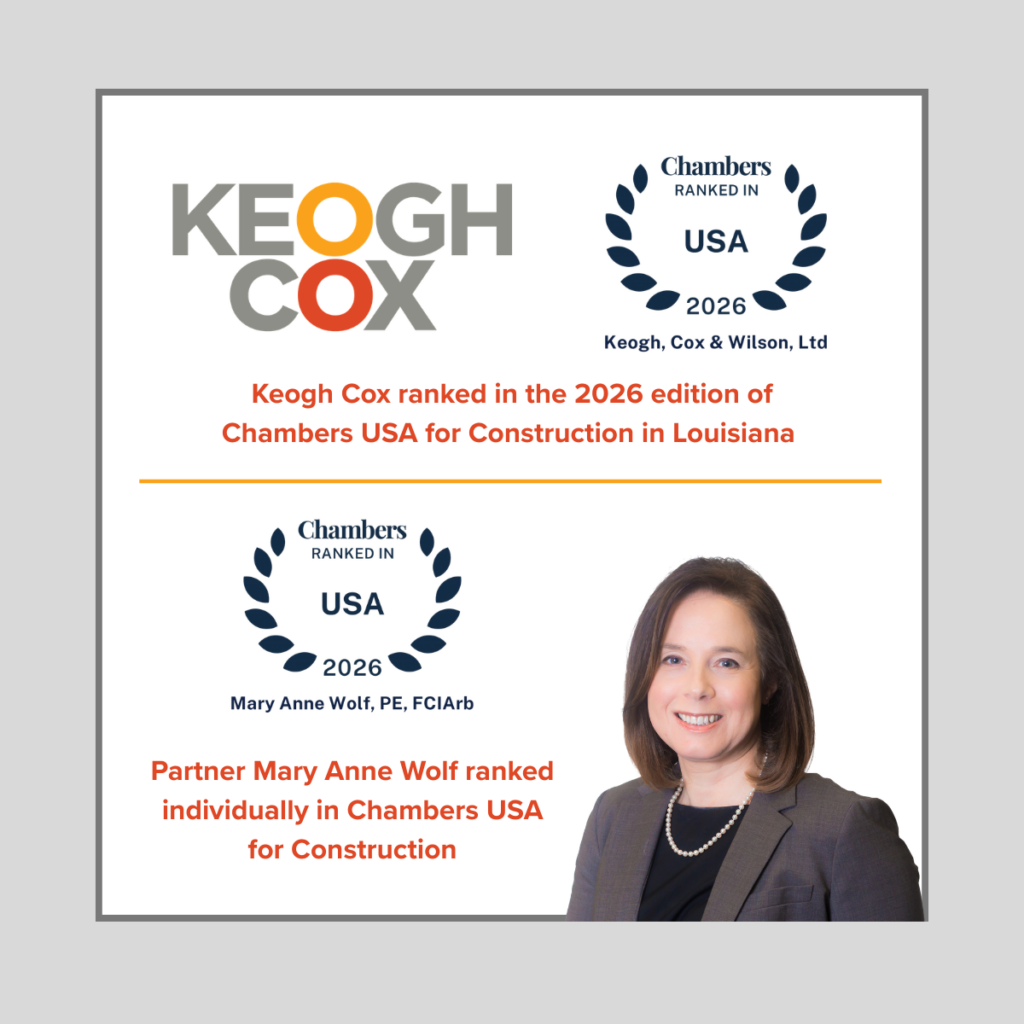
Keogh Cox is pleased to announce that our firm has been ranked in the 2026 edition of Chambers USA for Construction in Louisiana for the second year. Additionally, Partner Mary Anne Wolf has been individually ranked by Chambers for her work in Construction. We are proud of the outstanding work done by our Construction Group who made this ranking possible.

In Saizon v. Dow Chem. Co., the plaintiff was injured while he was working for Turner Industrial Group at the Dow Chemical Plant in Plaquemine, Louisiana. The plaintiff named Dow and three of its employees as defendants. The Dow defendants moved for summary judgment on grounds that the plaintiff was Dow’s statutory employee at the time of the accident and therefore the Louisiana Workers’ Compensation Law (“LWCL”) provided plaintiff with his exclusive remedy for the claims he asserted against Dow and its employees.
The trial court agreed and granted summary judgment in favor of the defendants. The First Circuit affirmed summary judgment on appeal.
The Court found the contract executed between Dow and Turner Industries created a rebuttable presumption under La. R.S. 23:1061(A)(3) that Dow was the plaintiff’s statutory employer at the time of the accident. The plaintiff failed to produce evidence to rebut this presumption. Accordingly, the defendants argued plaintiff’s exclusive remedy was found in workers’ compensation, not in tort.
The LWCL generally holds that an employer is immune from tort actions brought against it by its employee. However, the LWCL includes an “intentional act exception,” where an employee can maintain a tort claim if he can show that his accident and injuries resulted from his employer’s intentional act. A plaintiff can establish the intentional act exception if he can show the employer “knows that the result is substantially certain to follow from his conduct.”
The plaintiff argued that the defendants were aware of the risk that a fire or explosion could occur before the accident. He also argued the defendants failed to follow Dow’s safety policies and OSHA guidelines at the time of the accident. Plaintiff argued this created an issue of fact regarding whether the accident was “substantially certain.”
The First Circuit disagreed, finding this evidence amounted to only “generalized knowledge of risk” that “falls short of the kind of actual intention to injure that robs the injury of accidental character.” In short, the court agreed with the defendants’ position that “an employer’s generalized knowledge of risk does not meet the intentional act test without proof of specific knowledge of risk to this plaintiff and moving ahead with operations anyway.” Plaintiff had no such evidence, and his claims were dismissed.
Reference:
Saizon v. Dow Chem. Co., 2025-1139 (La. App. 1 Cir. 4/24/26), 2026 WL 1122621

On January 1, 2026, the Louisiana Legislature fundamentally changed how damages for medical specials are evaluated. By amending Louisiana Revised Statute § 9:2800.27, the Louisiana Legislature redefined how medical write-offs, “attorney discounts” and medical funding agreements are handled in personal injury cases. Following these amendments, a plaintiff’s financial recovery should be limited to the amounts actually paid to medical providers.
Louisiana’s collateral source framework historically created a significant gap between billed medical costs and actual medical payouts. Previously, juries only reviewed the plaintiff’s gross, unadjusted medical bills, while any discounted portion of those bills was not introduced as evidence. For example, even if a medical provider billed $100,000 but only received $25,000 in payment, the jury still reviewed and calculated a potential damage award based upon the billed $100,000 amount.
Generally, the trial judge was instructed to reduce the award, after the verdict, to the actual paid rate, and then apply a discretionary penalty, up to 40% of the write-off differential, to offset the plaintiff’s costs and attorney’s fees. This system established a higher baseline for initial evaluation, which influenced settlement negotiations and the claimed value of the alleged injury.
Act 466 of the 2025 Legislative Session eliminated the post-trial hearing mechanism and repealed the 40% procurement allowance. Under the current language of La. R.S. § 9:2800.27(B), a plaintiff’s past medical expense recovery is strictly limited to the amount actually paid to the contracted healthcare provider by a health insurance issuer, Medicare, or Medicaid, along with any applicable cost-sharing liabilities like deductibles or copays. The statute now provides that juries must now be shown both the amount billed and the amount actually paid. Additionally, when counsel secures a pre-negotiated rate with a medical provider, the recovery is capped at that negotiated rate rather than the inflated “sticker price.”
It is unclear what impact these changes will have on leverage and negotiation tactics during litigation. For example, will plaintiffs shift their strategy to now include an increased medical costs projection to recoup the “billed” medicals they previously claimed under the prior rule? The answer remains unknown. However, the amendments to the collateral source rule represent a substantial shift in how personal injury damages are evaluated, to which both plaintiff and defense counsel must adjust.

In a recent Louisiana Supreme Court decision, Lacy v. Ibarra, et al, the Court provided further instruction and clarification on exceptions to the “going and coming” rule, which provides employers generally are not liable for acts or omissions of their employees as they travel to or from work.
The plaintiff in Lacy alleged that she and her daughter were injured after they were involved in a car accident with the defendant. The defendant was an employee of Exxon who recently relocated to Baton Rouge, Louisiana from Houston, Texas. The employee had not secured a permanent residence in Louisiana. His family remained in Houston. At the time of the accident, the defendant was driving to work in his personal vehicle.
Plaintiff claimed that Exxon should be liable under the “special mission” and/or the “interest in transportation” exceptions to the “going and coming” rule. The Louisiana Supreme Court rejected both exceptions.
The Court noted the “special mission” exception applies in circumstances where the employee’s travel is a special or unusual, employment-related task outside the scope of the defendant’s normal job duties. The Lacy Court found that the defendant “was simply going to work” at the time of the accident. Therefore, the “special mission” exception did not apply. The Court also explained the employee’s recent relocation was not the type of “unusual” circumstance usually needed for the exception to apply.
The Court also found that the “interest in transportation” exception did not apply. This exception applies when an employer specifically pays the employee for the travel that is being done at the time of the accident. This can occur when an employer pays an employee for actual mileage for transportation from one point to another and, from both the employee and employer’s perspective, the purpose of the transportation is primarily for the employee’s benefit. In Lacy, the employer provides its employee with general transportation and relocation expenses. However, those general payments did not transform an ordinary commute into an employment-related activity or establish that the employer became interested in the employee’s transportation to trigger the exception.
The Lacy decision further solidifies Louisiana law that an employee’s travel to or from work, without any special circumstances, is not within the course and scope of an employee’s employment for purposes of vicarious liability.
Reference:
Lacy v. Ibarra, et al, 2025-01599 (La. 4/21/26), --- So.3d ----, 2026 WL 1074083.
The First Circuit Court of Appeals affirmed the Trial Court’s ruling that granted summary judgment in a premises liability case filed following an accident that occurred at the LSU Hilltop Arboretum. The Louisiana Supreme Court recently denied writs seeking review of the lower courts’ rulings. Keogh Cox attorneys, Brian T. Butler and C. Reynolds LeBlanc, defended the case.
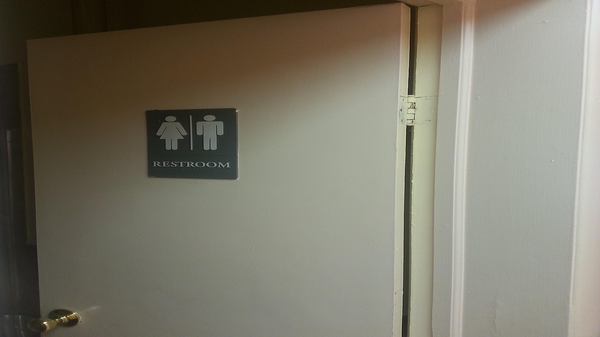
In Hebert v. Louisiana State Univ. Sys. Bd. of Supervisors Through Louisiana State Univ., the plaintiff went to the LSU Hilltop Arboretum to attend a wedding. Before the wedding, she went to the ladies’ room located in the outdoor pavilion area. The door to the restroom is controlled by an automatic door closer. The plaintiff alleged that the door began to close with “excessive force” when she exited the ladies’ room, and her finger was injured when it slid into the hinge-side of the door.
The plaintiff claimed the automatic door closer was defective because it was not properly adjusted at the time of the accident. The plaintiff retained an expert professional engineer to support her claims. The expert inspected the door and the door closer approximately 19 months after the incident. He testified that when he inspected the door, it was closing too fast, was out of adjustment, and had been improperly maintained. The plaintiff argued these findings showed the door was also defective at the time of the accident.
The expert also said the doors should have been inspected and adjusted every six months. The plaintiff argued the alleged problem with the door would have been discovered if it was inspected as her expert recommended.
Keogh Cox filed a Motion for Summary Judgment on behalf of the defendants. First, we argued the plaintiffs failed to produce evidence that the door was defective on the date of the accident. While the expert opined the door was defective when it was inspected nineteen months after the accident, the plaintiff had no evidence to show the alleged defect existed at the time of the accident. Keogh Cox asserted that the expert’s testimony claiming a defect was pure speculation. The court agreed and found the plaintiff failed to show the door presented an unreasonable risk of harm.
Second, we argued the plaintiff could not show LSU had prior notice that the door was defective at the time of the accident. As the door to the primary restroom on the premises, it was frequently used. There was no evidence of any prior complaints or reports of problems with the door before the accident. The plaintiff argued that notice could be found because LSU did not have a set inspection plan for the door as her expert recommended.
The court rejected this argument, stating “The opposite is true; in the absence of other facts such as recorded complaints about a defect or hazard, the lack of a plan of inspection implies that the public entity has no knowledge of dangerous defects or conditions.” Thus, the court found the plaintiff failed to show LSU had notice of the alleged problem with the door.
Reference:
Hebert v. Louisiana State Univ. Sys. Bd. of Supervisors Through Louisiana State Univ., 2025-0246 (La. App. 1 Cir. 11/7/25), 424 So. 3d 809, writ denied, 2025-01542 (La. 2/10/26), 425 So. 3d 1205.
Keogh Cox is pleased to announce that seven attorneys were named to the 2026 Louisiana Super Lawyers list:
Partner Christopher K. Jones is also recognized as a 2026 Louisiana Top 50 Super Lawyer.Four attorneys were selected to the 2026 Louisiana Super Lawyers “Rising Stars” list:

In Webber v. City of Shreveport, No. 56,705-CA (La. App. 2 Cir. Dec. 17, 2025), the Louisiana Second Circuit recently affirmed summary judgment in favor of the defendants in a trip-and-fall case involving a cracked sidewalk.
The plaintiff alleged she tripped and fell over an uneven area of the sidewalk in front of the defendant’s business. The defendant moved for summary judgment, arguing that the plaintiff could not establish (1) a defect creating an unreasonable risk of harm or (2) the defendant knew or should have known of any defect. The defendant produced evidence to show it had no notice of any defect and no prior accidents in the area where the plaintiff fell. The defendant also produced photographs showing no holes in the area and no differences in elevation exceeding one inch.
In support of her claims, the plaintiff provided evidence including testimony from a corporate representative of the defendant who admitted to knowledge of cracks in the sidewalk prior to the plaintiff’s accident.
However, the court importantly distinguished that knowledge of a condition is not the same as knowledge of an unreasonably dangerous condition. The defendant maintained that not all cracks in sidewalks present unreasonably dangerous conditions. It also offered proof that the subject portion of the sidewalk was traveled every day as the building’s main passage. There were no prior complaints regarding its condition, nor were there any prior accidents.
Based upon this evidence, the court found that the plaintiff failed to prove that the cracks in the sidewalk were unreasonably dangerous or that the defendants had any actual or constructive notice of the defect’s existence. Summary judgment was affirmed in the defendant’s favor.
Reference: Webber v. City of Shreveport, 56,705 (La. App. 2 Cir. 12/17/25), 425 So. 3d 485.

Mary Anne Wolf, PE, Esq, will present Resolving Design & Construction Disputes – How to Minimize the Risk and Expense in Lafayette on March 4, 2026.


In Ames v. Ohio Department of Youth Services, the U.S. Supreme Court recently clarified an important issue under Title VII of the Civil Rights Act of 1964. The Court addressed whether employees who belong to “majority groups” must meet a higher burden by proving “background circumstances” when bringing discrimination claims. The Court unanimously held that they do not.
The case involved an employee of the Ohio Department of Youth Services, who alleged she was denied a promotion and was later demoted because of her sexual orientation. The plaintiff is heterosexual, and her supervisor is homosexual. When the plaintiff sought the promotion, the position ultimately was awarded to a homosexual woman. After her demotion, plaintiff’s position also was filled by a homosexual man.
The plaintiff filed suit under Title VII, which prohibits employment discrimination based on protected characteristics, including sex. The district court dismissed her claims. It applied a rule requiring “majority-group” plaintiffs, i.e., plaintiffs who are not part of a minority group, to prove additional “background circumstances” suggesting the defendant is “the unusual employer who discriminates against the majority” employees.
The Supreme Court unanimously vacated the lower court’s ruling. The Court focused on the statutory text of Title VII, which protects “any individual” from discrimination. The statute does not distinguish between majority and minority groups.
The Court held Title VII does not impose a higher evidentiary burden on plaintiffs who are part of a majority group. Therefore, the “background circumstances” rule applied by the lower courts imposed an additional evidentiary burden on majority group plaintiffs that was inconsistent with the statute.
This decision resolved a split among lower courts regarding this issue and confirmed that Title VII discrimination claims should be evaluated equally for all employees.
Reference:
Ames v. Ohio Department of Youth Services, 605 U.S. 303, 145 S. Ct. 1540, 221 L. Ed. 2d 929 (2025).